
- On This Page:
- Freight modes
- Customs
- Challenges
- Mistakes
- Checklist
Shipping to Papua New Guinea
Complete Freight Guide
This guide covers how freight moves from Australia into PNG, what you need for customs clearance, how to choose between Port Moresby and Lae, and what to prepare before your cargo leaves Australian shores.
KalTrack provides real-time visibility across the entire route, so you can identify delays before they become demurrage charges.
Kalgin’s Port Moresby and Lae branches manage customs clearance, permit coordination, and inland logistics across the PNG network.
With our new office open in Lae, you have on-the-ground support at both major gateways.
Talk to Kalgin about your PNG logistics
Shipping to Port Moresby and Lae, PNG
Papua New Guinea is one of Australia’s largest and most dynamic freight destinations. The country imports over PGK 26 billion* in goods annually and works closely with overseas suppliers for mining equipment, fuel, manufactured goods, food, and medical supplies. Australia is PNG’s largest trade partner, supplying heavy machinery, vehicles, refined petroleum, and commercial goods across this corridor every week.
*The Papua New Guinean Kina (PGK) has averaged approximately 0.35 Australian Dollars (AUD) over the past 5 years.
What does PNG mainly import?
Transporting freight into Papua New Guinea requires more than simply arranging a vessel. The customs procedures are highly structured and exacting, while the choice of port influences subsequent inland logistics. Errors can rapidly escalate costs through demurrage penalties, biosecurity holds, and documentation mistakes, which are among the primary causes for shipment delays at the border.
PNG imports most of its manufactured goods, industrial inputs, fuel, and food because the country’s domestic manufacturing and refining base is still developing. According to the PNG National Statistical Office, total imports reached PGK 26 billion in 2024, up 59% from PGK 16 billion in 2020. Major imports break down as follows:
PNG Major Import Categories
Import Category
2024 Share
Who Needs It?
Common Freight Mode
Machinery and electrical parts
24.5% (PGK 6.0B)
Mining, oil and gas, civil contractors, utilities
FCL, breakbulk, project cargo, air freight for urgent parts
Mineral products (fuel and energy)
19.2% (PGK 4.71B)
National power grid, transport sector, extractive sites
Bulk liquid tankers, ISO tanks
Vehicles and transport equipment
11.7% (PGK 2.88B)
Logistics providers, mining operators, government
RoRo, FCL, breakbulk
Consumer and manufactured goodstransport equipment
3.3% (PGK 806M)
Retailers, supermarkets, general population
LCL, FCL
Construction materials
Included in broader categories
Government (Connect PNG programme), commercial developers
Breakbulk, FCL (heavy-rated)
Food and beverage
Included in consumer goods
General population, expatriate mining camps
FCL (reefer), LCL, air freight for perishables
Pharmaceuticals and healthcare
Included in consumer goods
Department of Health, private clinics, NGOs
Air freight (cold chain), FCL (reefer)
Chemicals and regulated goods
Included in intermediate goods
Mining, commercial agriculture
FCL (dangerous goods), ISO tanks
Australia is the primary regional supplier for heavy excavation machinery, civil engineering equipment, vehicle parts, and quality-assured consumables. When critical equipment needs replacing at a remote mine site, downtime costs can exceed AUD 80,000 per day. In those scenarios, air freight from Brisbane or Sydney is the practical choice, despite the premium.
Vehicle imports grew 116% between 2020 and 2024. The demanding condition of PNG’s road network shortens vehicle life cycles, which drives a steady replacement cycle for trucks, trailers, and 4×4 fleets.
How does freight move from Australia to PNG?
Ocean freight is the primary mode for commercial and industrial cargo. Direct liner services from Australia’s east coast (Sydney, Melbourne, Brisbane, Townsville) and Darwin connect to the two main PNG ports: Motukea (Port Moresby) and Lae.
A standard ocean shipment from Brisbane to Motukea or Lae takes between 14 and 18 days, depending on vessel routing and transshipment requirements. Services run on approximately 14-day frequency cycles. Major carriers on this route include Swire Shipping and ANL, both operating multi-purpose geared vessels that can handle containers (FCL and LCL), breakbulk, and out-of-gauge project cargo.
Geared vessels are a structural feature of this trade lane. Many PNG ports are served by vessels carrying their own onboard cranes, which discharge cargo independently of shore-side equipment.
Air freight is reserved for high-value, time-critical, or perishable goods. PNG has fewer international flight connections than major global hubs, so belly-hold and freighter capacity is limited and priced accordingly. For mining support, the cost of flying a 450 kg replacement part from Brisbane to Lae (approximately AUD 5,000) is often justified when it prevents a multi-day shutdown costing hundreds of thousands of dollars in lost production.
LCL consolidation is the standard choice for smaller commercial shipments (generally under 12 to 15 cubic metres) moving to Port Moresby or Lae. It reduces base shipping costs but adds time for deconsolidation at the destination port.
FCL is the standard for bulk commodities, FMCG, and larger equipment. Full containers provide better security against theft and weather exposure, which matters on routes involving transshipment to islands or road transport through the Highlands.
Should I ship to Port Moresby or Lae?
This is the most important routing decision you will make when shipping to PNG. There is no road connecting Port Moresby to the rest of the mainland, so port selection determines your entire inland distribution pathway.
Motukea (Port Moresby) serves the National Capital District and the broader southern region. It feeds the government administration centre and PNG’s largest concentrated consumer market. Cargo arriving here stays in the southern region, or it must be flown or shipped via coastal feeder vessels to other southern outports like Alotau.
Lae is PNG’s industrial logistics hub and the coastal terminus of the Highlands Highway. Any cargo destined for the Highlands provinces (Enga, Hela, Southern Highlands) or the Momase region must route through Lae. This port handles the highest volume of heavy freight, vehicles, and project cargo in the country. Its operational capacity directly supports the interior resource sector.
The rule is straightforward: if your cargo’s final destination is Port Moresby or the southern coast, ship to Motukea. If it is heading to the Highlands, the Momase coast, or the northern interior, ship to Lae.
Kalgin’s Port Moresby and Lae branches coordinate both gateway routes. Our new office in Lae provides direct on-ground support at the country’s primary industrial freight hub. This dual-gateway coverage means your cargo is managed locally at whichever port it enters.
How does cargo reach destinations beyond Port Moresby and Lae?
Reaching the international wharves is only the first phase. Inland and inter-island distribution is where PNG logistics requires the most planning.
Highlands Highway:
This 430-kilometre corridor from Lae through Nadzab and Goroka to Mount Hagen carries almost 80% of PNG’s economic activity. It is the only road link between the coast and the resource-rich interior. Operating heavy transport along this route requires planning for several realities:
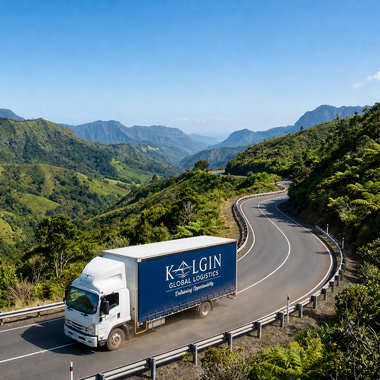
- Heavy rainfall, especially during La Niña events, can cause landslips, sinkholes, and road washouts. These result in multi-day closures that can strand truck convoys and affect the quality of temperature-sensitive goods in transit.
- Many bridges along the route are aging, single-lane Bailey bridges that have carried heavy freight for decades. The Asian Development Bank is funding the replacement of 71 bridges under the Sustainable Highlands Highway Investment Programme (SHHIP), which is progressively renewing the corridor’s infrastructure.
- Road access along sections of the highway can occasionally be affected by local issues that require coordination and resolution before traffic resumes. For high-value freight, security risk management (such as route planning, secure stops, and convoy options where appropriate) is commonly built into the transport plan.
- Security escorts, secure compound warehousing, and daytime transit schedules are standard practice for high-value freight. These arrangements form part of the baseline inland haulage budget.
Wider shipping and island destinations:
To reach PNG’s broader archipelago and roughly 15 declared outports (including Alotau, Buka, Kavieng, Kieta, Kimbe, Madang, and Rabaul), cargo undergoes coastal transshipment. Domestic operators like Consort Express Lines provide scheduled services connecting Lae and Port Moresby to the islands.
Transshipment adds transit time, increases the handling factor from multiple crane lifts, and introduces schedule variability from weather in the Bismarck and Solomon Seas. Port infrastructure outside Lae and Motukea varies by location and operating arrangements. A 2024 inquiry by PNG’s Independent Consumer and Competition Commission (ICCC) noted that many outport wharves and jetties are managed by local communities or provincial authorities; capacity and maintenance settings can influence the types of vessels that can berth and the pace of cargo discharge.
In areas without regular commercial liner services, final distribution may rely on smaller vessels. In these cases, plan for lower cargo volumes per sailing, additional handling steps, and weather-related schedule changes.
Papua New Guinea Customs and Compliance
What documents do I need for PNG customs clearance?
All commercial imports into PNG must be declared using Customs Form 15, known as the Single Administrative Document (SAD), lodged electronically through the ASYCUDA World system.
For most commercial imports, entries are lodged through a PNG-licensed customs broker in ASYCUDA World, authorized via a Form G26 appointment that you typically sign before loading.
Every commercial import entry typically requires the broker to lodge the Customs Form 15 (SAD) in ASYCUDA World and upload supporting documents such as:
- Tax Identification Number (TIN) of the PNG consignee (registered with the Investment Promotion Authority)
- TIN registered with the PNG Customs ASYCUDA World (AW) system — importers must complete this registration before an entry can be lodged
- Commercial invoice with full transaction details
- Detailed packing list
- Bill of lading (for sea freight) or air waybill (for air freight)
- Bank telegraphic transfer copies or payment receipts proving the underlying financial transaction
- Certificate of Conformity (CoC) for applicable goods
- Import permits for any restricted or regulated goods (NAQIA, Department of Health, Department of Environment and Conservation, as applicable)
Timing matters. PNG Customs’ import procedures describe lodgement of the import declaration (Customs Form 15) in ASYCUDA World up to five working days before arrival, and no later than five working days after the ship/aircraft reports its arrival. PNG Customs also notes exceptions where a full import entry is not required (for example, certain personal/household effects, and single shipments with a dutiable value not exceeding PGK 5,000 which must still be reported in a simplified form; goods with a dutiable value not exceeding PGK 250 are duty-free).
After assessment, duties and taxes are generally payable within five clear working days from the Notice of Assessment; PNG Customs notes interest (e.g., 8%) may apply for late payment and that cash is not accepted (electronic/EFTPOS methods are used).
Customs valuation in PNG is based on the price paid or payable for the goods when sold for export to PNG (the transaction value), with adjustments required under PNG valuation legislation. PNG Customs’ valuation guidance also notes that the customs value is determined at CIF level (including the cost of overseas freight and insurance to PNG). Where Customs has reason to doubt the truth or accuracy of the declared value, it may seek additional evidence and apply alternative valuation methods in accordance with the valuation framework.
Kalgin’s customs team coordinates documentation pre-departure from Australia, ensuring the SAD is ready to lodge within the required five-day window before vessel arrival. This removes one of the most common causes of demurrage in the PNG corridor.
What duties and taxes apply to imports into PNG?
PNG levies import duties based on the Harmonised System (HS) tariff classification of your goods. Rates vary by product category. A 10% Import Goods and Services Tax (GST) applies to most imports. Specific categories attract excise duty on top of the base tariff.
Used vehicles sit in a higher-duty category. Excise rates range from 20% to 120% based on engine capacity, determined by the Tariff Specification Code (TSC). Accurate classification at this level matters to avoid retrospective duty assessments.
The PNG Customs Service applies the Customs Tariff Act framework for classification and administers compliance through audit and enforcement. PNG Customs guidance notes that false, misleading, or incorrect declarations are serious offences and can lead to enforcement action including seizure and prosecution. For administrative enforcement, PNG Customs’ Penalty Notice System describes penalties commonly ranging from 50% to 200% of the duty unpaid/not declared/attempted to be avoided (and where goods are exempt/free/zero-rated, a penalty may be applied as a percentage of the goods’ value). Importers should keep complete records to support classification and valuation in case of post-clearance review.
Which goods need special permits or compliance attention in PNG?
Several cargo types require permits, licenses, or pre-arrival approval from agencies beyond the PNG Customs Service.
Food and agricultural products: The National Agriculture Quarantine and Inspection Authority (NAQIA) review all food imports, agricultural products, timber, and used machinery to protect PNG from pests and diseases. Import permits must be applied for through the NAQIA online portal before shipment. English labelling must comply with the PNG Food Sanitation Act 1991. NAQIA inspection fees were updated by 12% in 2025.
Used machinery and vehicles: These require biosecurity clearance to confirm no soil or seed contamination. Offshore cleaning certificates are required. Valuation discussions around depreciation are common, and precise TSC mapping is needed for excise duty on vehicles.
Chemicals and dangerous goods: Industrial chemicals, mining solvents, and agricultural pesticides require environmental, and biosecurity permits from the Department of Environment and Conservation and NAQIA before shipment. Safety Data Sheets (SDS) must be provided in advance, and transport must comply with international IMDG codes. Cargo shipped without the right permits in place will be held at the border.
Pharmaceuticals: Most prescription medicines and many medical devices supplied in PNG are imported. Import requirements can vary by product category and the status of the importer under the Medicines and Cosmetics Act 1999 (administered by the National Department of Health’s Pharmaceutical Services Standards Branch and the Pharmacy Board). For controlled medicines (including narcotic and psychotropic substances), an additional Drug Import Licence is required and the nominated consignee/contact must be an appropriately registered health professional (e.g., a registered medical practitioner, dentist, veterinary surgeon, or pharmacist), with the importing establishment appropriately licensed. Cold-chain logistics remain critical for temperature-sensitive products—plan packaging, monitoring, and contingency storage end-to-end.
Prohibited goods: PNG restricts the import of certain items including non-degradable plastic bags (HDPE), counterfeit currency, flick knives, seditious literature, and specific bird plumage. Communication equipment requires explicit ministerial permission.
Cargo Type
Primary Agency
Key Risk
Required Action
Used machinery and vehicles
Customs, NAQIA
Biosecurity holds, valuation queries, high excise
Offshore cleaning certificates, accurate TSC mapping
Chemicals and dangerous goods
Dept of Environment, NAQIA
Border hold without permits
Safety Data Sheets, environmental and biosecurity permits, IMDG compliance
Food and perishables
NAQIA, Food Sanitation Council
Quality loss during document holds, labelling rejection
Prior NAQIA import permits, English labelling per Food Sanitation Act 1991
Pharmaceuticals
Department of Health
Non-compliant medicines held at border
Confirm DoH/Pharmacy Board requirements for the product and importer; Drug Import Licence applies for controlled (narcotic/psychotropic) medicines; ensure licensed consignee/establishment and cold-chain plan where required
Standard commercial cargo
Customs (ASYCUDA)
HS code misclassification, retrospective duty bills
Pre-verify tariff classification, consider binding tariff rulings for complex goods
What are the biggest freight challenges when shipping to PNG?
PNG’s geography and infrastructure create logistics factors that differ from other Pacific Island destinations. Understanding them in advance helps you plan realistic timelines and budgets.
Challenge
Operational Impact
How to Mitigate
Highlands Highway disruptions
Weather-related landslips and bridge renewal works can cause delays, strand cargo, and affect perishable quality
Buffer inventory planning, GPS tracking, local liaison to anticipate closures
Route Security
Route disruptions and isolated incidents of cargo theft can affect transit timing and cargo security
Security escorts for high-value cargo, daytime driving, convoy arrangements
Coastal transshipment delays
Extended transit to islands, handling exposure from double-handling at intermediate ports
Robust export packaging (heavy crating, shrink-wrapping), align international vessel arrivals with feeder schedules
Outport infrastructure variability
Some wharves have limits on heavy lifts or modern container handling
Pre-shipment port surveys for project cargo, use carriers with self-geared vessels
Foreign exchange timing
FX availability has periodically extended import payment cycles
Maintain buffer stock, factor FX clearance time into order cycles
Demurrage and detention costs
Penalties of USD 75 to USD 150 per container per day once free time expires
Pre-lodge documentation, ensure duties are paid within the five-day window
Foreign exchange availability is worth flagging. PNG’s FX market has been constrained for several years, though conditions have steadily improved. The Bank of Papua New Guinea’s crawling peg mechanism resulted in a 14% nominal depreciation of the Kina against the US dollar between mid-2023 and late 2024. By early 2025, FX clearance times had improved from around four weeks to less than one week. For importers, a softer Kina raises landed cost, while FX timing can extend procurement lead times.
Kalgin Market Updates
Stay Ahead of Your Supply Chain!
Forewarned is forearmed. Anticipate supply chain changes with Kalgin’s free, exclusive monthly market updates.
SUBSCRIBE
Mistakes importers commonly make when shipping to PNG
Underestimating demurrage exposure.
PNG ports generally allow three to five days of free time for terminal demurrage and seven to ten days for container detention. Clearing customs and arranging trucking can take longer than this window when documentation needs correction, a bank transfer is delayed, or NAQIA flags a container for inspection. Once free time expires, penalties accrue at USD 75 to USD 150 per day. Weekends and public holidays do not pause the clock.
Ignoring the true landed cost.
Some importers price their shipments based on the ocean freight quote alone, overlooking import processing charges, port service charges, quarantine and inspection fees (updated in 2025), and inland cartage surcharges that fluctuate with diesel prices. Choosing the cheapest freight quote can lead to exposure from higher destination handling fees or a local agent who cannot clear goods within free time.
HS code and valuation errors.
The PNG Customs Service applies classification rules consistently. Misclassification can trigger penalties of 50% to 200% of the short-paid duty. ASYCUDA maintains historical valuation data that flags unusual declarations. False declarations can result in seizure and further action.
Assuming Australian logistics norms apply.
Inland transit in PNG involves security arrangements, daytime travel scheduling, and weather-related road closures that can last days. Cold-chain storage needs end-to-end temperature planning. These realities belong in every timeline and budget.
Incomplete biosecurity preparation.
Used machinery and vehicles arriving without offshore cleaning certificates face quarantine holds. Food arriving without prior NAQIA permits will be held at the border. Brown Marmorated Stink Bug (BMSB) season compliance requirements can mean mandatory re-export of non-compliant containers back to Australia.
What should I check before shipping freight to PNG?
Use this checklist before cargo departs Australia:
- Confirm consignee registration. Verify the PNG consignee holds a valid Tax Identification Number (TIN), is registered with the Investment Promotion Authority (IPA), and has their TIN registered in the PNG Customs ASYCUDA World system. Without this registration, an entry cannot be lodged.
- Appoint a licensed broker early. Engage a PNG-licensed customs broker using Form G26 well before loading. Do not wait until the vessel departs.
- Validate HS codes and valuation. Pre-verify tariff classification. Ensure the commercial invoice reflects the true transaction value and explicitly separates freight and insurance costs to satisfy the CIF valuation rules.
- Secure permits for regulated goods. Apply for NAQIA or Department of Health permits through the relevant online portals before shipment. Original permits must be presented for clearance. Goods arriving without prior approval will be held.
- Audit documentation for consistency. Ensure exact alignment across the purchase order, commercial invoice, packing list, and bill of lading. Any discrepancy in weights, values, or descriptions can trigger an ASYCUDA audit. Confirm BMSB compliance to avoid forced re-export.
- Select the correct port gateway. Route to Motukea for Port Moresby and southern destinations. Route to Lae for the Highlands, Momase, and northern interior.
- Plan for inland distribution. If freight is heading beyond the port, confirm inland transport arrangements including security escorts, convoy scheduling, and bridge weight limits for heavy loads.
- Arrange marine cargo insurance. Given the exposure to open-water transits, multiple crane lifts during transshipment, and inland security arrangements, cargo insurance is a necessity rather than an optional add-on.
How can a freight forwarder reduce risk on the PNG corridor?
The most common point of breakdown in a PNG supply chain is the handoff between port arrival, customs clearance, and inland cartage. Forwarders who manage this cycle end-to-end eliminate the communication gaps that lead to demurrage.
A freight forwarder operating effectively in PNG should provide:
- Pre-departure document control that ensures the PNG broker has everything needed to lodge the SAD within the five-day pre-arrival window
- On-ground customs brokerage with licensed brokers at the destination port, rather than relying on remote coordination
- Inland logistics coordination including security arrangements, trucking capacity, and real-time tracking through the Highlands corridor
- Permit and compliance management for regulated goods, handling NAQIA, Department of Health, and environmental permits before cargo ships
- Marine cargo insurance arranged as standard, not offered as an afterthought
Do PNG’s challenges apply to other Pacific Island destinations?
Many of the factors described here are familiar across the wider Pacific. Limited vessel frequency, transshipment coordination, outport infrastructure variability, and strict biosecurity are common themes in Fiji, Vanuatu, New Caledonia, Tonga, Samoa, and the Solomon Islands.
That said, PNG has some distinct logistics factors:
- The Highlands Highway is a corridor unlike any other in the Pacific. No other Pacific Island nation has a comparable inland freight artery combining geotechnical factors, security planning, and bridge infrastructure renewal.
- Scale of the import market is significantly larger. At PGK 26 billion annually, PNG’s import demand is considerably greater than other Pacific Island economies, which creates different capacity pressures and commercial dynamics.
- Foreign exchange timing has been a consideration in PNG for longer than in most other Pacific markets, adding a financial planning layer to procurement.
- Inland security planning for road freight is a more prominent operational factor in PNG than in Fiji, Tonga, or Samoa.
For businesses already shipping to Fiji or other Pacific destinations through Kalgin’s network, the PNG corridor adds a few planning layers. But the core principle remains the same: preparation, documentation accuracy, and an on-ground partner at the destination make the difference between a controlled supply chain and a costly one.
When should I choose air freight, LCL, FCL, or project cargo?
Air freight is the right choice when operational downtime costs exceed the freight premium. Emergency replacement parts for mining and resource operations, cold-chain pharmaceuticals, and high-value perishables are the primary use cases. Limited belly-hold capacity on PNG routes means booking early and confirming space allocation.
LCL (Less than Container Load) works for smaller commercial shipments moving to Port Moresby or Lae. It reduces base shipping costs compared to booking a full container. Allow additional time for deconsolidation at the destination CFS.
FCL (Full Container Load) is the standard for bulk goods, FMCG, and equipment. The sealed container provides stronger security and weather protection. This matters for cargo that will undergo transshipment to island ports or travel the Highlands Highway.
Breakbulk and project cargo planning is necessary for out-of-gauge mining equipment, heavy construction materials, and any cargo that does not fit standard container dimensions. This requires booking geared vessels with onboard heavy-lift cranes. Conduct inland route surveys to confirm that bridges along the Highlands Highway can support the gross weight of your transport configuration.
Kalgin: PNG & Pacific Islands Shipping Leaders
Kalgin PNG manages customs clearance, permits, and inland logistics across the PNG network.
With our new office in Lae, in addition to Port Moresby, you have local support at both primary gateways – along with KalTrack real-time visibility across the entire route.
Talk to Kalgin about your next PNG shipment.
Resources for Shipping to PNG
- Shippers’ Letters of Instruction
- Kalgin Australia SLI
- Kalgin New Zealand SLI
- Kalgin Fiji SLI
- Kalgin Papua New Guinea SLI


